
POCKET BLOGS: Saye What?

In last week’s inaugural installment of Pocket Blogs by Kate Pitt, we introduced you to Lord Saye, a.k.a. That One Random Head on a Pole in Henry VI Part II. This week Kate will show us how that one random head on a pole is connected to EVERYTHING.


Last week I hinted that one of the reasons I’m fond of Lord Saye in Henry VI Part II is that he is related to Shakespeare. While that isn’t strictly true, he is related to the Shakespeare I grew up with as a millennial with a VCR and a pulse: Joseph Fiennes in Shakespeare in Love. 
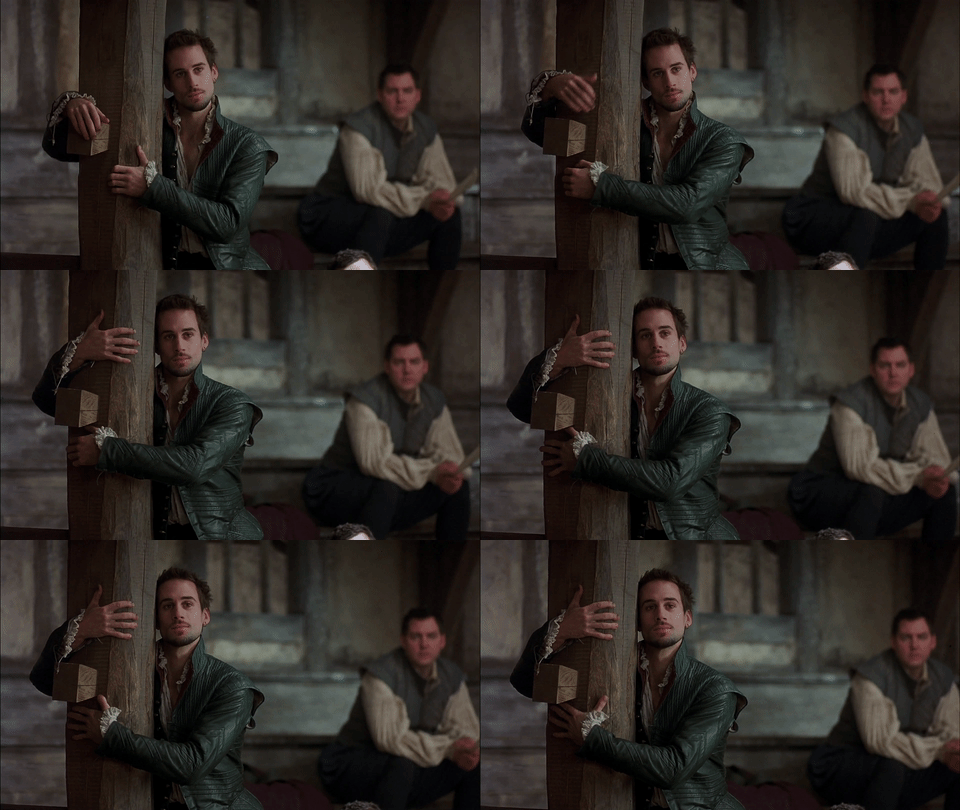
65931b623ebc6a5270210da222596d8b.gif

The full name of the historical Lord Saye in Henry VI Part II is James Fiennes, first Baron Saye and Sele. Joseph Fiennes and his brother Ralph are members of the Twisleton-Wykeham-Fiennes family and descended from the sixteenth Baron Saye and Sele, the Venerable Frederick Twisleton-Wykeham-Fiennes, who traces his lineage all the way back to the first Lord Saye who met a sticky end at the hands of Jack Cade back in 1450. 

Both brothers’ acting pursuits have repeatedly brought them close to their Shakespearean past. Ralph Fiennes has played many, many, Shakespeare roles to great acclaim, and one of his earliest was Henry VI at the Royal Shakespeare Company in 1988. That production was an adaptation of four plays (the three Henry VI plays and Richard III) into three plays (called Henry VI, Edward IV, and Richard III) and collectively known as The Plantagenets. There were at least some severed heads on pikes in that production, which means there is a decent chance that Ralph Fiennes crossed paths backstage with a prop head representing one of his ancestors.  

PB-003-LordSaye-3.jpg

The current Lord Saye, Nathaniel Thomas Allen Twisleton-Wykeham-Fiennes, 21st Baron Saye and Sele, is 100 years old, served honorably in WWII, and still lives in the family home. That home is Broughton Castle, originally built in the 14th century and passed down in the Fiennes family since 1457 when the son of Shakespeare’s Lord Saye, William Fiennes, the 2nd Lord Saye and Sele, succeeded in right of his wife to it

In addition to being the Fiennes family home, Broughton Castle is often used as a filming location and was the home of Gwyneth Paltrow’s character Viola de Lesseps in Shakespeare in Love. Yes, Joseph Fiennes played Shakespeare at the home of his third cousin once removed. The dance where Will meets Viola was filmed in the Great Hall, Colin Firth is grumpy in the Oak Room, and the balcony scene was filmed in the garden. 

To sum up, not only does a Fiennes (James) appear in a Shakespeare play as a character, but a Fiennes (Ralph) has appeared in a Shakespeare play depicting that Fiennes (James), and his brother Fiennes (Joseph) has played Shakespeare at the home of the son (William) of the first Fiennes (James). 

SayeConspiracy.jpg
unnamed.png

I first discovered this Fiennes frenzy rolling when I lived in Saybrook College as an undergraduate. Saybrook College is named after the town of Old Saybrook where Yale was originally founded. The town is named after Saybrook Colony which was named after the first Viscount Saye and Sele who helped fund it along with a Baron Brooke. The Saybrook college arms are a quartering of the Saye and Sele/Fiennes arms (three gold lions on a blue background) and the Brooke arms, which is how I spent a significant amount of time in college writing papers while wearing sweatpants with the heraldry of a minor Shakespeare character on them. 

Saybrook College today is known for its two beautiful courtyards and “the Saybrook Strip” whereby residents enthusiastically remove plus or minus most of their clothes during the third quarter of a football game. We also honor the memory of Lord Saye with an annual “Saye and Sele Day” celebration, which recently included a mechanical shark.

Not every Shakespeare character with only two scenes has quite as much backstory as Lord Saye. His death is memorable and moving on its own, but next time you see Henry VI and he makes the cut, you can connect him to all the ways his life brushes against yours. Shakespeare is brilliant at sketching out characters and then shading in their hearts with a single line – “She was too good for me”, “I was adored once, too” – that tells us about their past. Lord Saye is interesting for all the ways his life reverberates in his future and our present. 

by Kate Pitt


Interested in more deep dives into Shakespeare characters? Check out friend-of-Good-Tickle-Brain Hailey Bachrach’s dramatis personae, explorating the canon one character at a time. 

POCKET BLOGS: Saye Anything

Hey everyone! Mya here. I’m really excited today to introduce a new feature here on Good Tickle Brain: POCKET BLOGS! As regular readers will know, since 2019 I have been working on my comics with the world’s first, foremost, and possibly only pocket dramaturg, Kate Pitt. (For more on Kate, including the etymology of the term “pocket dramaturg”, check out this Q&A with her.)

Kate is, if anything, an even bigger Shakespeare geek than me, and certainly has a bigger Shakespeare brain. I will often text her a random Shakespeare fact and say “Isn’t this cool?”, only to receive back “YES, and…” followed by a dozen more related facts, complete with footnotes. As I am taking the month off, I thought it only fair to share some of her delightful geekery and expertise with all of you.

So sit back and get ready to peer into some of the most geeky, random, and entertaining corners of the Shakespeare-verse with Good Tickle Brain’s new series of POCKET BLOGS!


Spare a thought for poor Lord Saye. The ill-fated lord’s entrance in Henry VI Part II is often overlooked because he arrives at the same time as Queen Margaret. Margaret makes consistently dramatic entrances across the four Shakespeare plays she appears in and there is an excellent chance that someone is about to be stabbed, slapped, or screamed at if she is nearby. 

In this scene, Margaret enters carrying the severed head of her very dead ex-lover the Duke of Suffolk, and talks affectionately to it while her husband King Henry desperately tries to work out how to put down a major rebellion. 

Saye is in the middle of all this and spends most of his first scene (and he’s only got two) standing around awkwardly while the King and Queen talk to everyone who isn’t him. It can’t feel great to be ignored in favor of someone who is missing his trunk and all of his limbs, and when King Henry finally turns towards Saye it is to point out that the advancing rebels would very much like to turn his head into a tote bag just like Suffolk’s.

PB-001-LordSaye-1.jpg

Cue the awkward laughter and a messenger running in with the news that the rebels have arrived and everyone present who still has their heels should immediately betake themselves to them and get out of town. King Henry reminds Lord Saye that everyone hates him (because he raised taxes and can speak French) and he should probably join the bravely-running-away royals. 

Lord Saye however, declares that he will stay and face the rebels. He is innocent after all. Why should he flee when he has done nothing wrong? At this point, practiced Shakespearean audiences will be reaching for the popcorn. Declaring innocence never ever (ever) works when attempting to avoid unpleasant consequences in Shakespeare and indeed, Lord Saye is captured less than forty lines later and dragged before the rebels to be interrogated. 

Jack Cade, the leader of the rebellion, accuses Saye of such abominable crimes as printing, teaching grammar to children, and dressing his horse in excessively fancy horse-clothes. Saye is definitely not guilty of the first indictment, as this scene takes place in 1450 and the first books in England weren’t printed until at least twenty-five years later.

Regardless, the rebels continue to hurl increasingly ridiculous accusations at Lord Saye – “thou hast men about thee that usually talk of a noun and a verb” – while he confidently bats them aside by speaking Latin and quoting Caesar’s Commentaries. Not necessarily the best strategy when negotiating with angry men with pikes, but Saye also demonstrates that he can speak eloquently in plain English: 

Tell me, wherein have I offended most?
Have I affected wealth or honor? Speak.
Are my chests filled up with extorted gold?
Is my apparel sumptuous to behold?
Whom have I injured, that you seek my death?
These hands are free from guiltless blood-shedding,
This breast from harboring foul deceitful thoughts.
O, let me live! 

Lord Saye’s contention that his hands are “free from guiltless blood-shedding” is equivocal, given that he menacingly indicates elsewhere that he has definitely shed some blood: “Great men have reaching hands. Oft have I struck those that I never saw, and struck them dead.” There were rumors that Saye was involved in the murder of Henry VI’s uncle Duke Humphrey, though Shakespeare depicts that death as definitely Suffolk’s fault.

In addition to being a cunning politician and a huge classics nerd, Lord Saye is also a war hero. Jack Cade contemptuously challenges him, “when struck’st thou one blow in the field?” but Saye fought with Henry V in France. He is now in his mid-fifties and past his fighting days (the rebels mock his palsy) but Lord Saye feels that his prior service to his country should save his life. 

PB-001-LordSaye-2.jpg

Cade disagrees. Even though he admits, “I feel remorse in myself with his words”, he orders Saye to be dragged offstage and beheaded. The rebels also break into Saye’s son-in-law’s house and behead him too. They then put both their heads on pikes and parade around London smushing the heads together to make them look like they are kissing because the rebels are apparently twelve. 

“For with these borne before us, instead of maces, will we ride through the streets, and at every corner have them kiss.”  (BBC Shakespeare, The Second Part of Henry the Sixt, 1983)

“For with these borne before us, instead of maces, will we ride through the streets, and at every corner have them kiss.” (BBC Shakespeare, The Second Part of Henry the Sixt, 1983)

Lord Saye is one in a long line of Shakespeare characters who appear briefly and die quickly. Cinna the Poet in Caesar, Young Seward and The Family Macduff in Macbeth, Cornwall’s servant in Lear: all of their deaths, like Saye’s, serve to make the bad guys look worse. However, Jack Cade and his crew have already murdered innocent people before Saye comes on the scene, so what does his death teach the audience that they don’t already know? Dramatically, there may be an argument for cutting this scene. Next week however, I’ll explain the extravagantly silly reasons why I am delighted by Lord Saye and think he should be in every production. (Hint: he’s related to Shakespeare!)

by Kate Pitt

Shakespearean History Bingo

One final remastered and expanded Shakespearean bingo card today. I’ve saved my favorite genre for last: history!

Consulting pocket dramaturg: Kate Pitt

Consulting pocket dramaturg: Kate Pitt

I haven’t worked it all out, but I suspect this is the easiest card to get “bingo” on, given the preponderance of Henries, Edwards, Richards, Yorks, Lancasters, and Gloucesters.

Here’s the original:

20150113-S-ShakespeareanHistoryBingo.jpg

Many MANY thanks to my pocket dramaturg, Kate Pitt, for collaborating with me on these. Two heads are often better than one, especially when one of them is Kate’s.

I’m taking May off! Because I really need to. There may or may not be some fun filler content, depending on <gestures vaguely> circumstances. Either way, I’ll see you back here in June for some more Shakespeare fun!

Come Together (Write Now)

We interrupt your Shakespearean bingo cards to bring you a song to celebrate Shakespeare’s birthday tomorrow! (If you’re not familiar with the tune, get caught up here first.) ALL TOGETHER NOW!

Consulting pocket dramaturg: Kate Pitt

Consulting pocket dramaturg: Kate Pitt

For more fun Shakespeare birthday content, check out my brand new Man From Stratford archive page!

GTB Archive Updates: The Man From Stratford

It’s SHAKESPEARE’S BIRTHDAY WEEK! To celebrate, I’ve collected all the comics I’ve drawn about Shakespeare the man (as opposed to Shakespeare the golden retriever, or the plays of Shakespeare) in one place! Check it out for an overview of Shakespeare’s life, several Shakespeare-themed song parodies, and many past celebratory birthday comics.

Shakespearean Tragedy Bingo (Remastered)

Let’s continue with more remastered and expanded Shakespearean bingo cards! Up today is tragedy.

Consulting pocket dramaturg: Kate Pitt

Consulting pocket dramaturg: Kate Pitt

The free square used to be “very poor life decision” but that proved harder and less satisfying to draw than a big ol’ pile of bodies.

Here’s the original:

20150120-S-ShakespeareanTragedyBingo.jpg

Upcoming Event

It’s Shakespeare’s birth month, and you know what that means… lots of random online events celebrating Shakespeare! I’m excited to be a part of Hark Journal’s birthday celebration this year.

GTB Archive Updates: Musical Parodies

If you’ve been following my work here for a while, you know I love writing musical parodies. Seriously, I can’t get enough of it. And now you can browse all my musical parodies in one place!

In related news, I got a ukulele last year and am planning to put together “The Song Book of Shakespearean Parodies That Are Particularly Easy to Play on the Ukulele” sometime in the uncertain future. Don’t hold your breath, but it’s going to happen.

Shakespearean Comedy Bingo (Remastered)

Just over six years ago I drew a series of bingo cards for each of Shakespeare’s major genres. They weren’t perfect; for starters, they were a 4x4 grid instead of the standards 5x5 grid. So, to celebrate Shakespeare’s birth month, I decided not only to give them the old “remastering” treatment, but also to team up with my pocket dramaturg, Kate Pitt, to add nine extra squares per card. Print them out and bring them to the next Shakespeare play you see!

Consulting pocket dramaturg: Kate Pitt

Consulting pocket dramaturg: Kate Pitt

Here’s the original:

20150106-S-ShakespeareanComedyBingo.jpg

I keep picking things to “remaster” with the idea that they will be quicker and easier to do than original comics, to give me some time to work on other projects. I keep being proven wrong.

Upcoming Event

It’s Shakespeare’s birth month, and you know what that means… lots of random online events celebrating Shakespeare! I’m excited to be a part of Hark Journal’s birthday celebration this year.